Estate Management Software for Multi Estate Operators
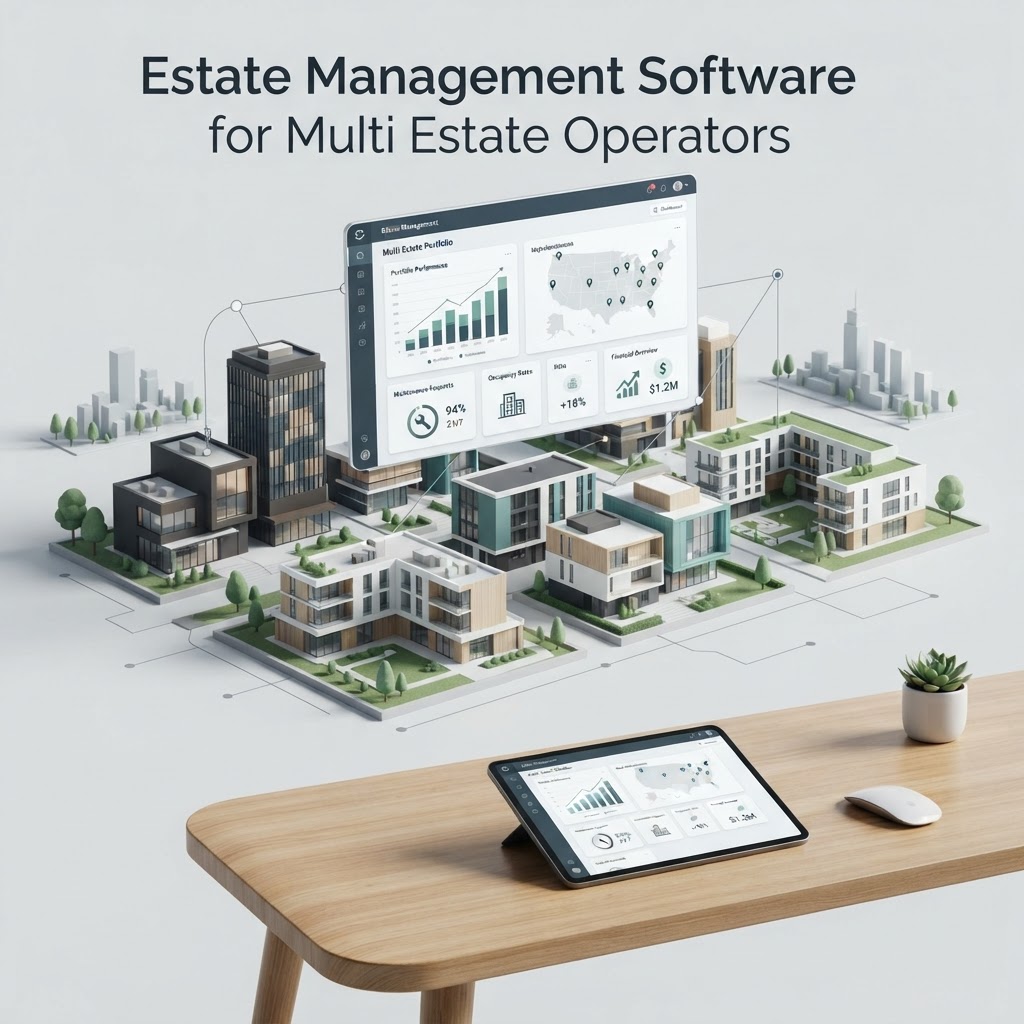
Managing a single residential estate is demanding enough. Managing five, ten, or twenty across different locations in Nigeria introduces a level of operational complexity that spreadsheets, WhatsApp groups, and manual gate logs simply cannot handle. For property management companies and multi-estate operators, the gap between what legacy systems offer and what modern operations demand is widening — and the cost of that gap is measured in delayed payments, security incidents, and resident dissatisfaction.
Estate management software for multi-estate operators has evolved from basic record-keeping tools into comprehensive operating platforms. The most capable solutions today centralize security, billing, maintenance, and resident communication into a single, intelligent system — giving portfolio managers the visibility and control they need to run multiple communities at scale. This article examines how that transformation works, why it matters specifically for Nigerian residential communities, and what to look for when evaluating platforms for your portfolio.
Why Is Manual Management Failing Multi-Estate Operators?
The Hidden Costs of Fragmented Operations
When a property management company operates multiple estates using disconnected tools — spreadsheets for billing, physical logbooks for visitor records, phone calls for maintenance requests — it isn't just inconvenient. It is operationally unsustainable.
Data silos are the first and most persistent problem. When each estate maintains its own records in isolation, managers at the portfolio level have no consolidated view of performance. Comparing service charge collection rates between Estate A and Estate B requires manually pulling figures from different sources, reconciling inconsistent formats, and hoping nothing was recorded incorrectly. According to research by Deloitte on real estate operations, operational inefficiency in property management can consume up to 30% of potential revenue — a figure that compounds significantly when multiplied across multiple sites.
The financial impact of delayed service charge reconciliation is equally damaging. Manual invoicing processes lead to collection delays, disputes, and cash flow shortfalls that make it difficult to fund maintenance or security upgrades. Without automated reminders and digital payment trails, chasing arrears becomes a full-time job.
Security inconsistency is perhaps the most serious risk. When different estates under the same management umbrella operate with different visitor protocols — one using a logbook, another using a basic spreadsheet, another relying on memory — the portfolio as a whole becomes vulnerable. A single poorly managed access event can create liability and reputational damage that affects every estate in the group. Standardization across sites is not optional for serious operators; it is essential. Reviewing your current processes against an estate management app features checklist is a practical first step toward identifying where the gaps are most critical.
What Defines a True Multi-Estate Operating System?
Moving Beyond Basic Property Management Tools
The industry has matured beyond simple applications that digitize one or two processes. A true multi-estate operating system — sometimes called an EstateOS — integrates security, billing, maintenance coordination, and resident communication into a unified architecture. The distinction matters because partial digitization often creates new silos rather than eliminating old ones.
The defining feature of an EstateOS is centralized portfolio management. A manager overseeing eight estates should be able to log into a single dashboard, toggle between communities, compare key performance indicators, and drill down into specific issues — without switching platforms or logging into separate systems. This centralized oversight enables standardized operating procedures to be enforced across the entire portfolio, ensuring that the quality of management at the largest estate is replicated at the smallest.
Equally important is role-based access control. In a multi-estate environment, not every user should see the same data or perform the same actions. Security personnel at one gate need access to visitor logs and entry approval workflows. Facility managers need visibility into maintenance tickets and contractor assignments. Estate administrators need billing dashboards and financial reports. Residents need a self-service interface for submitting requests and making payments. A properly architected system assigns each role precisely the tools and data visibility it requires — no more, no less. This protects data integrity across the portfolio and reduces the risk of unauthorized actions or information leaks.
Standardized processes are the operational backbone of a successful multi-estate platform. When billing cycles, maintenance workflows, and visitor management protocols are configured uniformly and enforced by the platform itself, the operator no longer depends on individual staff compliance to maintain quality. The system becomes the quality standard. For managers considering this transition, the estate management software implementation guide provides a structured framework for rolling out these capabilities across multiple sites without disruption.
The shift from managing estates reactively to operating them strategically is what separates platform-driven operations from manual ones. An EstateOS makes that shift possible.
How Does Digital Transformation Improve Security and Trust?
Leveraging Real-Time Intelligence for Safer Communities
Security is the foundation on which resident trust is built. In Nigerian gated communities, where residents specifically choose estate living for its safety and controlled access, any weakness in access management erodes that trust rapidly. Digital transformation of security operations addresses this at every layer.
AI-powered visitor management, built on QR-based digital passes, eliminates the human errors and manipulation that plague manual gate logs. When a resident invites a guest through a mobile app, the system generates a unique, time-bound QR code that the visitor presents at the gate. Security personnel scan it, the system validates it instantly, and the entry is recorded with a timestamp and the approving resident's identity. There is no ambiguity, no manual recording, and no opportunity for unauthorized passes to be reused. According to the Nigerian Institution of Estate Surveyors and Valuers, accountability in estate access management is one of the most frequently cited concerns among residents evaluating gated community options.
Real-time notifications extend this transparency beyond the gate. When a visitor is approved, the resident receives an instant notification. When a maintenance technician enters a unit, it is logged and visible. When a service charge payment is processed, the resident and the administrator both receive confirmation. This continuous digital audit trail serves a dual purpose: it deters misconduct and it provides evidence when disputes arise. In a market where residents have historically struggled to get clear answers from management, this level of transparency is genuinely transformative.
Centralized security reporting is the portfolio-level benefit that manual systems cannot replicate. When all estates feed incident data, visitor logs, and access events into a single analytics engine, operators can identify patterns — a specific time window when unauthorized access attempts spike, an estate with unusually high visitor rejections, a security team that consistently delays approvals. These insights are invisible in a fragmented system. With centralized intelligence, they become actionable. The best estate management platforms in Nigeria are increasingly differentiated by the quality of their security analytics, precisely because operators recognize this advantage.
Can Automation Really Reduce Administrative Overhead by 70%?
Streamlining Billing, Maintenance, and Resident Communication
The claim that automation can reduce administrative overhead by up to 70% is not hyperbole when you examine where estate managers actually spend their time. The majority of daily administrative activity in a typical Nigerian residential estate involves three repetitive workflows: chasing service charge payments, coordinating maintenance requests, and responding to resident inquiries. Automation targets all three simultaneously.
Automated service charge billing transforms cash flow management. Rather than manually generating invoices, tracking which residents have paid, and personally following up on arrears, the platform issues invoices automatically on a defined cycle, sends payment reminders at configured intervals, and updates records in real time as payments come in. The result is faster collections, fewer disputes, and financial reports that managers can access at any moment without manual reconciliation. Research by McKinsey on property management automation indicates that automated billing in residential management can reduce collection cycles by up to 40% — a significant improvement for portfolios where cash flow timing directly affects operational capacity.
A unified maintenance ticketing system delivers comparable efficiency gains on the operational side. When a resident submits a maintenance request through a mobile app, it enters a structured workflow: it is categorized, assigned to the appropriate team or contractor, given a resolution timeline, and tracked to completion. Every action is logged. Managers can see at a glance how many open tickets exist across the portfolio, which contractors are performing well, and which requests have exceeded resolution targets. This replaces the chaos of WhatsApp messages and verbal instructions with a system that creates accountability at every step.
The resident-facing dimension of automation is equally important. When residents can submit requests, check payment histories, approve visitors, and communicate with management through a dedicated mobile app, the volume of inbound inquiries to the estate office drops dramatically. Residents who feel empowered to handle their own interactions through a transparent system are also more satisfied — and more likely to pay on time and comply with estate rules. For guidance on optimizing how this communication layer is structured, estate resident communication best practices offers practical frameworks drawn from successful estate operations. The combination of automated billing, structured maintenance workflows, and resident self-service is where the 70% efficiency figure becomes credible and achievable.
How Do You Choose the Right Software for Your Portfolio?
Evaluating Scalability, Reliability, and Local Relevance
Selecting estate management software for a multi-estate portfolio is a strategic decision that will affect operations, resident experience, and financial performance for years. The evaluation process should be rigorous and based on criteria that reflect the specific demands of African residential communities.
Begin with scalability requirements. A company managing three estates today may manage fifteen in three years. The platform must accommodate growth in units, users, and estates without requiring re-implementation. Small-scale operators may begin on entry-level plans suited for up to 50 units, while enterprise operators running large-scale portfolios require custom integrations, dedicated support, and unlimited unit capacity. Confirm that the vendor's pricing and architecture support this trajectory before committing.
Local relevance is non-negotiable. Generic property management software designed for Western markets assumes infrastructure, regulatory environments, and resident behaviors that do not apply in Nigeria. Payment integrations, for example, must support local gateways and mobile money options. Security workflows must account for the realities of gated community culture in Lagos, Abuja, and Port Harcourt. Platforms purpose-built for African residential communities will always outperform adapted Western tools in these areas. A detailed comparison of locally relevant platforms is available in the NokVision vs EstateMaster for Nigeria analysis.
Use a structured vendor evaluation checklist that covers uptime reliability — 99.9% availability should be the minimum standard for any production estate platform — data security protocols, GDPR-aligned or equivalent data handling practices, and the vendor's track record with estates of similar size and complexity. Request references from existing clients and ask specifically about support response times during incidents. For a comprehensive framework, the estate management software ROI calculator guide helps quantify the financial return of moving to a platform-based approach, making the business case clearer for decision-makers. Finally, consult the estate management software FAQs Nigeria to address common implementation and contractual questions before signing any agreement.
Conclusion
The operational demands of running multiple residential estates in Nigeria have outgrown the capabilities of manual systems. Fragmented tools create security vulnerabilities, billing inefficiencies, and communication failures that damage both revenue and resident trust. A purpose-built estate management platform — one that functions as a true operating system rather than a collection of disconnected apps — gives multi-estate operators the centralized visibility, automated workflows, and real-time intelligence they need to manage communities at scale.
NokVision was built specifically for this challenge. As a complete estate operating platform designed for Nigerian and African residential communities, it integrates visitor management, service charge billing, maintenance coordination, and resident communication into one intelligent system — with role-based dashboards, real-time analytics, and the scalability to grow with your portfolio. Whether you manage a single community or a network of estates, the path from operational chaos to professional control starts with the right platform.