Best access control system for Nigerian estate
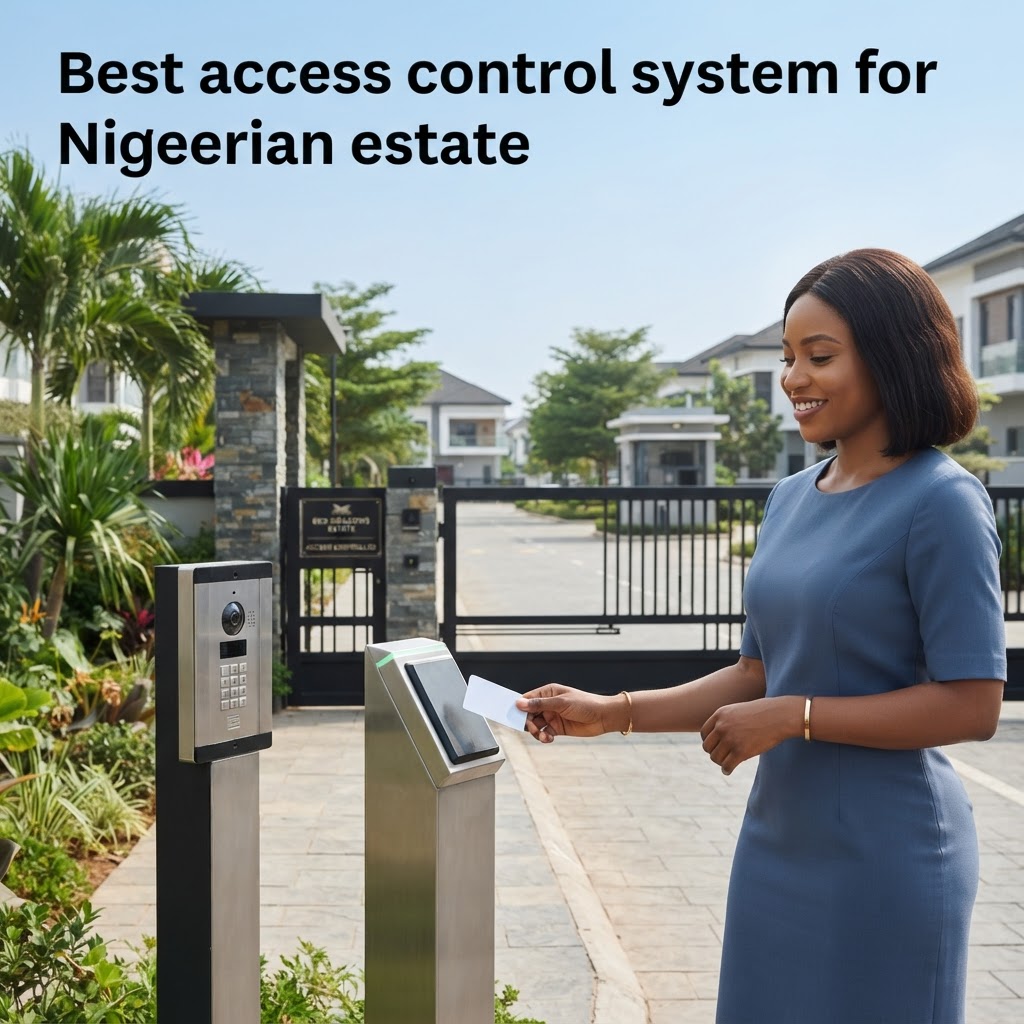
Modern Nigerian estates are under pressure. As gated communities expand across Lagos, Abuja, Port Harcourt, and other urban centres, the gap between the security infrastructure residents expect and what most estates actually deliver continues to widen. Visitor management remains largely paper-based, service charges are still collected manually in many communities, and security personnel are stretched thin trying to manage multiple entry points with outdated tools.
The consequences are real: unauthorised access incidents, resident frustration, and estate managers drowning in administrative tasks that could be automated. Choosing the best access control system for Nigerian estate environments is no longer a luxury — it is a foundational operational decision that directly affects the safety, efficiency, and reputation of residential communities.
This article examines what truly intelligent access control looks like, why legacy gate management systems are failing, and how integrated platforms are transforming estate operations across Nigeria.
Why is traditional gate management failing?
Hidden costs of paper logs and manual security
Nigerian estates that rely on handwritten visitor logbooks and manually operated gates are operating with a security model that was designed for a different era. The vulnerabilities in these systems are numerous, well-documented, and increasingly costly.
Paper-based visitor logs are highly susceptible to social engineering. A confident, well-dressed visitor can provide false information at a gate and walk in unchallenged because there is no verification layer — a guard can only match a name to a page, not to a verified identity or a prior approval. Research from physical security professionals consistently shows that unauthorised access incidents in residential communities are disproportionately linked to manual verification failure rather than perimeter breaches.
Operationally, manual gate checks create congestion. During morning and evening peak hours — when residents are commuting, contractors are arriving, and delivery services are active — a single bottlenecked entry point can delay dozens of vehicles. This is not a minor inconvenience; it is a daily source of resident frustration that directly affects estate satisfaction and retention.
Accountability suffers further when data is concerned. Handwritten records are illegible, incomplete, and easily manipulated. If an incident occurs and security teams attempt to review visitor history, they often find inconsistent entries, missing timestamps, or pages that have been removed. There is no tamper-evident audit trail, no way to cross-reference data, and no visibility into patterns. For estate managers trying to operate professionally, this is an unacceptable risk.
If you are already exploring broader operational improvements, how to manage a gated estate in Lagos provides practical guidance that complements any security upgrade investment.
What defines a truly intelligent access control system?
Beyond hardware — integrated digital ecosystems
The conversation about access control has historically centred on hardware: turnstiles, RFID card readers, intercom systems, and barrier gates. While these physical components remain relevant, they are no longer sufficient on their own. The most effective access control systems in 2024 and beyond are unified digital platforms that use hardware as one input layer within a much broader operational ecosystem.
The critical shift is from standalone security hardware to integrated visitor management, where every entry event generates data, triggers workflows, and feeds into a centralised dashboard. When a visitor arrives at a gate, an intelligent system does not simply log their name — it verifies a pre-approved digital pass, records their entry timestamp, notifies the relevant resident, and updates a live security dashboard simultaneously.
Real-time data visibility is what separates modern platforms from legacy systems. Estate managers no longer have to wait for end-of-day reports or manually compile security logs. Live dashboards give instant visibility into who is on-site, which contractors are working in which units, and whether any access anomalies require attention. This replaces security management by instinct with security management by intelligence.
Mobile-first design is equally important. The best systems are built around the reality that estate managers, residents, and security guards all operate primarily on smartphones — not desktop computers. Residents should be able to pre-register visitors from their phones, receive entry notifications instantly, and approve or deny access remotely. Security personnel should be able to scan digital passes with a mobile device rather than operating complex hardware terminals. When a platform is designed around how people actually work, adoption rates increase dramatically and operational friction decreases.
For a broader look at how technology is reshaping property operations in Nigeria, estate management software for Nigerian properties offers a useful overview of the landscape.
How do QR-based visitor passes enhance security?
Digital verification eliminates unauthorised access
QR-code-based visitor authentication represents one of the most practical and scalable advances in residential access control for Nigerian estates. The mechanics are straightforward but the security implications are significant.
When a resident invites a guest, they generate a digital visitor pass through their estate management app. This pass is tied to a specific visitor identity, a specific time window, and a specific access point. The pass is delivered to the visitor via SMS or messaging platforms. At the gate, a security guard scans the QR code using a mobile device. The system verifies the code against its database in real time, confirms validity, and either grants or denies access — all within seconds. Because the code is time-bound and single-use by design, it cannot be shared, reused, or forged in the way that a written note or a verbal authorisation can.
The audit trail generated by QR-based systems is one of their most operationally valuable features. Every scan creates a timestamped record linked to a specific resident, visitor, and entry point. If an incident occurs, security teams can pull complete, accurate logs immediately. According to IFSEC Global, estates and commercial buildings that implement digital access verification report a measurable reduction in unauthorised entry incidents compared to manual checking environments.
The reduction in administrative overhead is equally significant. Security guards who previously spent their time writing names, car registration numbers, and phone numbers into logbooks — often inaccurately and under time pressure — now spend those seconds scanning a code. This frees their attention for actual security tasks: observing behaviour, monitoring perimeters, and managing simultaneous entry points. Human error is dramatically reduced because the verification is machine-executed rather than human-executed.
For large estates handling hundreds of daily visitor movements, this shift from manual writing to digital scanning can reduce gate processing time by up to 60%, meaningfully reducing peak-hour congestion and resident complaints.
What should estate managers look for in a provider?
Criteria for reliability, scalability, and local fit
Selecting an access control provider for a Nigerian estate requires criteria that go beyond feature lists and pricing tables. Four dimensions deserve serious evaluation: local contextual fit, system reliability, role-based flexibility, and scalable architecture.
Local contextual fit is perhaps the most underestimated criterion. Generic property management software designed for European or North American residential markets carries assumptions that do not hold in Nigerian contexts — assumptions about stable internet connectivity, consistent power supply, and tenant behaviour patterns that differ from those in gated communities in Lagos or Abuja. Platforms purpose-built for African residential environments are designed to handle connectivity intermittency, integrate with local payment gateways, and reflect the operational realities of multi-compound estates with diverse staffing structures. As Techcabal has noted, the most successful proptech solutions in Africa are those that solve African problems rather than adapting Western products.
System reliability must be evaluated with Nigerian infrastructure conditions in mind. A platform with 99.9% uptime reliability — which translates to less than nine hours of downtime per year — provides the operational continuity that estates cannot afford to lose. Dedicated local support is equally important; when a gate management issue occurs at 11pm, a support team operating in a different time zone offers limited practical value.
Role-based dashboards are an essential feature for estates with layered management structures. Residents, security guards, estate managers, and administrators have different information needs and different operational responsibilities. A system that delivers each user exactly the tools and visibility they require — without overwhelming them with irrelevant data — dramatically improves adoption and reduces operational errors. A security guard does not need access to billing data; an administrator does not need to see individual visitor scan logs in real time. Granular access controls protect data integrity while improving user experience.
Scalability matters for property management companies overseeing multiple estates. A platform built for multi-estate management, with centralised oversight, standardised workflows, and comparative analytics, provides exponentially more value than multiple single-estate tools operating in silos.
NokVision, available at Nokvision.com, is purpose-built for exactly this context — offering QR-based visitor management, role-based dashboards, 99.9% uptime reliability, and flexible pricing from ₦15,000 per month for estates of up to 50 units.
How does an integrated system transform estate operations?
Connecting access, billing, maintenance, and transparency
Access control does not exist in isolation. In a well-managed estate, every operational domain — security, billing, maintenance, communication — feeds into and depends on every other. The most transformative platforms recognise this interdependence and build it into their architecture.
Linking access control to service charge management creates a powerful accountability loop. When an estate's billing system and visitor management system share a unified data layer, managers can identify patterns that would otherwise be invisible — for example, correlating units with outstanding service charges against facility usage data, or ensuring that contractor access is linked to approved maintenance work orders rather than informal arrangements. Automated billing, payment reminders, and transparent financial reporting reduce collection delays and improve trust between residents and management.
Maintenance coordination benefits equally from integration. When residents submit maintenance requests through the same platform that manages their visitor passes and service charges, management teams can assign tasks, track progress, and close issues within a single workflow. There are no lost WhatsApp messages, no phone calls that went unlogged, and no confusion about whether a reported issue has been addressed. Residents have visibility into the status of their requests, which directly reduces the volume of follow-up complaints that typically consume significant management time.
Centralised data reporting is where the full value of integration becomes apparent. Estate managers who previously made operational decisions based on gut feeling and fragmented information can now work from comprehensive dashboards showing visitor traffic patterns, payment performance rates, maintenance resolution times, and facility usage trends. This is the foundation of professional estate administration — and it is what separates communities that improve over time from those that merely manage day-to-day.
For estates managing complex infrastructure alongside digital operations, related considerations like common solar panel problems and how to fix them and generator vs. solar inverter options for Nigerian homes are worth reviewing as part of a complete estate modernisation strategy.
According to Deloitte's Smart Building research, integrated property management platforms that unify security, operations, and resident experience deliver operational efficiency improvements of 40–70% compared to fragmented single-function tools.
Conclusion
Nigerian estates are at an inflection point. The security risks of paper-based access control are well-established, resident expectations for digital-first experiences are rising, and estate managers are under increasing pressure to deliver professional, accountable operations with limited resources.
The best access control system for Nigerian estate communities is not simply a gate barrier with a card reader. It is an intelligent, integrated platform that connects visitor management, resident communication, service charge automation, and operational reporting into a single unified system — purpose-built for the realities of Nigerian residential communities.
NokVision delivers exactly this: QR-based visitor verification, real-time security dashboards, automated billing, role-based access for all stakeholders, and the scalability to grow from a single estate to a multi-community portfolio. Trusted by over 50 estates and serving thousands of residents, it represents the most direct path from operational chaos to professional estate management.
Modern estate living should be secure, transparent, and frictionless. With the right platform in place, it can be.