Estate Security Audit Checklist for Property Managers
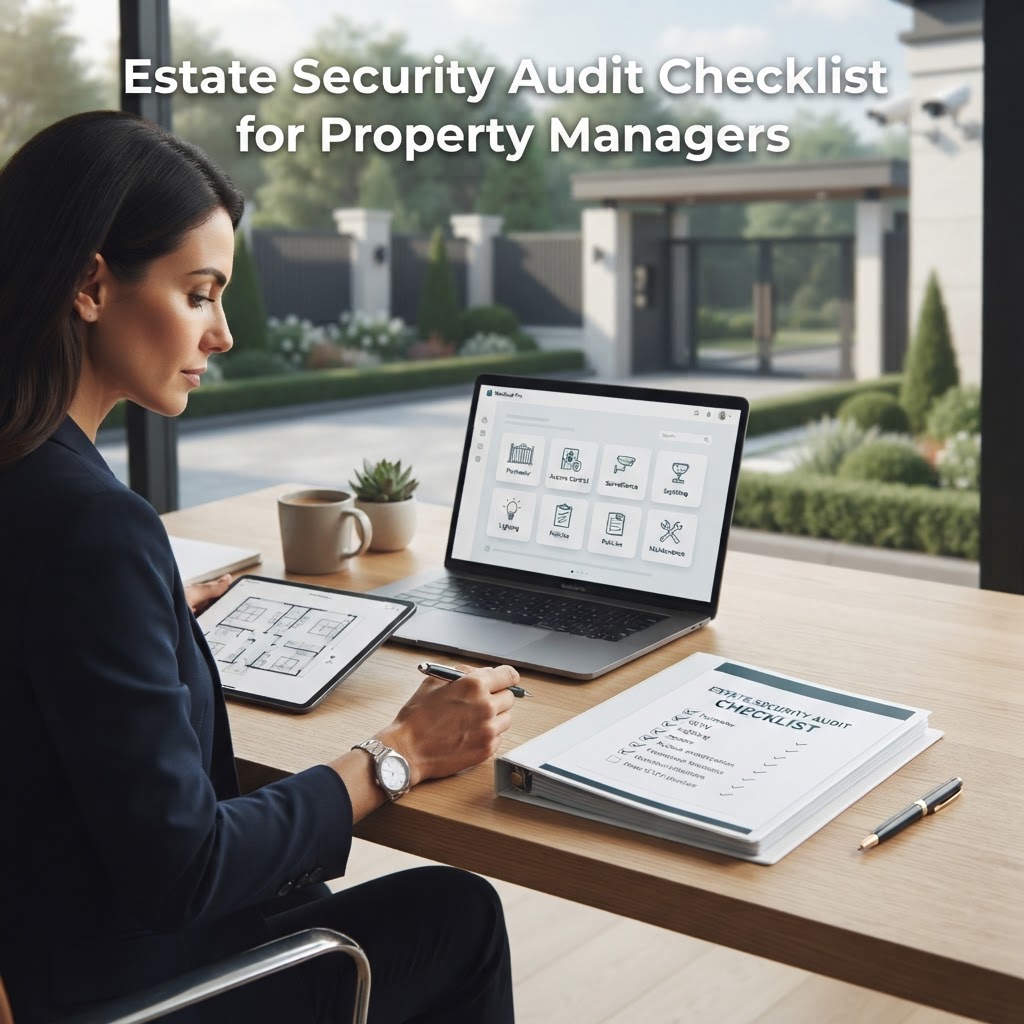
Security threats in Nigerian residential estates are evolving faster than most property managers can adapt. From unauthorized access at unmanned gates to compromised visitor logs and unresolved maintenance vulnerabilities, the risks are real, costly, and largely preventable. Yet many estates still rely on outdated manual processes that leave critical gaps in protection — gaps that only become visible after an incident occurs.
This estate security audit checklist for property managers is designed to change that. Whether you manage a single gated community or oversee a portfolio of serviced apartments and urban developments, this guide provides a structured framework for evaluating your current security posture, identifying weaknesses, and implementing improvements that protect residents, assets, and operational integrity.
A rigorous audit is not a one-time exercise. It is a disciplined, repeatable process that transforms estate security from a reactive function into a proactive system of continuous improvement.
Why Is a Regular Security Audit Essential?
Moving from reactive measures to proactive protection
The traditional approach to estate security in Nigeria has long been reactive: respond to an incident, investigate after the fact, update a procedure, and wait for the next problem. This model is fundamentally flawed. According to the Nigeria Security and Civil Defence Corps, a significant proportion of security breaches in residential communities involve insider knowledge or repeated patterns that go undetected precisely because no one is reviewing the data systematically.
Manual logbooks — the standard at most estate gates — are notoriously unreliable. Entries are illegible, records are incomplete, and there is no mechanism to cross-reference visitor history or flag anomalies. Worse, they are vulnerable to manipulation. A guard under pressure can alter a log retroactively, and no one would know. This is not a hypothetical risk; it is a documented pattern in estate security failures across Lagos, Abuja, and Port Harcourt.
Regular security audits address this by creating structured checkpoints where every layer of your security infrastructure is reviewed against a documented standard. They reveal drift — the gradual weakening of protocols over time as shortcuts become habits. They also provide the evidence base that justifies service charge expenditures to residents. When an estate manager can demonstrate that security investments have reduced unauthorized access by a measurable percentage, or that incident response times have improved, it builds the kind of resident trust that sustains healthy community relationships.
Proactive audits also ensure compliance with evolving industry standards. The ASIS International Physical Security Guidelines recommend that residential security systems be formally reviewed at least twice annually, with ad hoc reviews triggered by significant incidents or operational changes. Adopting this cadence positions your estate as a professionally managed community, not simply a collection of houses behind a gate.
How Do You Evaluate Physical Access Control?
Securing perimeters and entry points
Physical access control is the first and most visible layer of any estate security framework. A thorough audit begins at the perimeter and works inward, assessing every point where an unauthorized individual could gain entry.
Perimeter integrity should be evaluated systematically. Walk the full boundary of the estate and document any gaps in fencing, damaged barriers, or areas where vegetation provides concealment for perimeter scaling. Nigerian estates frequently underestimate the risk posed by perimeter degradation, particularly in older developments where maintenance budgets have not kept pace with physical wear. The International CPTED Association recommends clear sightlines, adequate lighting, and physical barriers that create measurable deterrence against opportunistic intrusion.
Gate infrastructure deserves dedicated scrutiny. Are boom barriers and sliding gates functioning reliably? Is the gate automation system connected to a backup power source that activates during PHCN outages? An estate that loses gate automation during a power cut and defaults to manual, unlogged access has effectively dismantled its access control system every time the lights go out. This is a critical vulnerability that many Nigerian estates have not formally addressed.
Visitor management processes represent perhaps the most consequential upgrade opportunity available to most estates today. The contrast between paper-based logs and digital QR-code verification is not merely one of convenience — it is a fundamental difference in accountability and auditability. As detailed in our comparison of estate visitor management: manual vs digital, paper logs cannot generate historical reports, cannot flag returning unauthorized visitors, and cannot notify residents of arrivals in real time.
QR-code-based visitor verification, by contrast, creates a timestamped, tamper-proof record of every entry and exit. When a resident pre-authorizes a visitor through a platform like NokVision, the security team receives the verification digitally, eliminating the margin for human error or deliberate falsification at the gate. This transition also reduces gate congestion, which is itself a security risk — long queues at entry points create pressure on guards to wave vehicles through without proper screening.
For a detailed comparison of technology options at the gate, see our analysis of estate access control: RFID, QR, or biometrics, which evaluates the practical trade-offs of each system for Nigerian residential communities.
What Role Does Real-Time Visibility Play?
Leveraging data to eliminate blind spots
Security is only as strong as the information available to decision-makers. An estate manager reviewing a paper incident report three days after the fact has no ability to intervene, escalate, or prevent recurrence. Real-time visibility fundamentally changes the security calculus by compressing the gap between event and response to near zero.
Centralized dashboards are the operational nerve center of modern estate security. When all visitor activity, maintenance personnel movement, gate events, and incident reports flow into a single live interface, patterns that would otherwise remain invisible become immediately apparent. A contractor who visited three different units within an hour, a visitor who entered but has no corresponding exit record, a gate that was opened manually during off-hours — these anomalies surface instantly in a well-configured dashboard and can be investigated before they escalate.
Audit trails are non-negotiable for accountability. Every entry and exit event should be logged with a timestamp, the identity of the visitor or vehicle, the resident who authorized access, and the security officer who processed the clearance. This level of granularity is essential during incident investigations. When a resident reports a theft, a harassment complaint, or an unauthorized presence, the ability to reconstruct a precise timeline of access events can mean the difference between resolution and a protracted dispute. The Estate Incident Reporting and Resolution Guide outlines best practices for building these investigation-ready records.
Real-time notifications extend security visibility directly to residents and managers, creating what NokVision describes as a "Security Through Visibility" environment. When a resident receives an instant mobile notification that their expected visitor has arrived and been cleared, it normalizes transparency as a feature of estate life. When a manager receives an alert that an unregistered vehicle attempted gate access, they can respond immediately rather than discovering the event in a weekly log review. This ambient awareness deters threats by signaling that the estate is actively monitored — a powerful deterrent in itself.
Research published by the Urban Land Institute consistently identifies real-time monitoring capabilities as one of the top factors residents in gated communities cite when evaluating the quality of their estate's security provision.
How Do You Bridge Physical and Digital Security?
Integrating platforms for seamless oversight
The most common failure mode in estate security is fragmentation. Physical security operates independently of resident communications, maintenance workflows exist in spreadsheets disconnected from access logs, and service charge administration has no visibility into operational performance. This siloed structure creates the exact conditions under which security risks flourish — no single person has a complete picture, and accountability diffuses across disconnected systems.
Unifying visitor management, service charge billing, and maintenance operations into a single platform eliminates these blind spots structurally. Consider a scenario where a maintenance contractor is scheduled to repair a water pump in a residential block. In a fragmented system, the estate manager books the contractor by phone, the security team is notified by a handwritten note slipped under the gatehouse door, and the resident has no visibility until the contractor knocks. In an integrated platform, the manager schedules the visit digitally, the security team receives an authorized access record with the contractor's details and time window, the resident receives a notification, and every entry and exit event is logged against the maintenance request. The entire workflow is traceable, auditable, and transparent.
This integration directly supports stronger security outcomes. When only pre-authorized individuals can be granted access — and that authorization is tied to a specific resident, a specific time window, and a specific purpose — the potential for unauthorized entry through social engineering or guard error is dramatically reduced. Our guide on how Nigerian estates can prevent unauthorized access examines these operational vulnerabilities in detail and provides specific mitigation strategies.
Role-based dashboards are a critical feature of this integrated approach. Security personnel need access to gate activity logs and visitor clearance queues — they do not need to see service charge payment histories. Residents need to manage their visitor lists and submit maintenance requests — they do not need visibility into other residents' data. Estate managers need the full operational picture. When each user role receives precisely calibrated access, the system operates with both efficiency and appropriate information security.
NokVision's platform operationalizes this model through a unified operating system that connects all these functions with role-based access controls, real-time notifications, and centralized reporting. For property management companies overseeing multiple communities simultaneously, the platform's multi-estate architecture — detailed in our overview of estate management software for multi-estate operators — provides comparative analytics and standardized processes across an entire portfolio.
The efficiency gains from this level of integration are substantial. Estates that have migrated from fragmented manual systems to unified platforms consistently report reductions in administrative overhead of up to 70%, with corresponding improvements in response times for both security incidents and maintenance requests.
How Do You Maintain Long-Term Security Compliance?
Building a culture of continuous improvement
A security audit is only valuable if its findings drive action and if that action is verified over time. Sustainable estate security requires institutionalizing the audit process as a recurring organizational practice, not treating it as a project to be completed once and archived.
Bi-annual audits are the recommended baseline for most residential estates. The first audit, conducted at the start of the year, should assess hardware integrity, software system performance, staff compliance with documented protocols, and any incidents from the preceding period. The mid-year audit should verify that remediation actions from the first audit have been implemented and evaluate whether any new vulnerabilities have emerged. Estates that experience significant incidents, staff turnover, or operational changes should trigger ad hoc reviews outside this standard schedule.
Staff training is a persistent gap in Nigerian estate security. Security guards are often the weakest link not because of intent but because of inadequate preparation. Every member of the security team should be trained on the estate's access control procedures, the digital visitor management system, emergency escalation protocols, and incident documentation requirements. Training records should be maintained and reviewed during each audit cycle.
Documented protocols matter as much as technology. Even the most sophisticated digital platform cannot compensate for undefined procedures. Your audit checklist should verify that written protocols exist for visitor screening, unauthorized access attempts, equipment failure contingencies, and emergency response. For a comprehensive framework on the latter, the Estate Emergency Response Plans for Nigerian Communities provides a practical template.
Security Compliance Checklist for Property Managers
Use this summary checklist to track your audit progress:
- Physical Infrastructure: Perimeter integrity confirmed, gate automation tested, backup power verified, CCTV coverage mapped
- Access Control Systems: Visitor management platform operational, QR verification active, paper log dependencies eliminated
- Digital Operations: Real-time dashboard active, audit trail generation confirmed, role-based access controls configured
- Staff Compliance: Training records current, protocols documented and distributed, incident reporting process understood by all team members
- Reporting and Analytics: Monthly security reports generated, incident metrics tracked, visitor activity trends reviewed
- Resident Communication: Notification system active, resident onboarding complete, feedback channels established
Conclusion
Security in modern Nigerian estates is not a static condition — it is an ongoing operational discipline that requires structured attention, the right tools, and a commitment to continuous improvement. This estate security audit checklist for property managers provides the framework to move from reactive, fragmented security practices to a proactive, integrated system that protects residents and demonstrates professional management standards.
Platforms like NokVision are purpose-built to support this transformation, combining QR-based visitor management, real-time dashboards, role-based access controls, and unified operational reporting into a single system designed specifically for African residential communities. Whether your estate is just beginning its security modernization journey or looking to optimize an existing digital infrastructure, the principles in this checklist provide a reliable roadmap.
Audits create accountability. Technology creates visibility. And together, they create the secure, well-managed residential communities that residents deserve and property managers are proud to operate.